
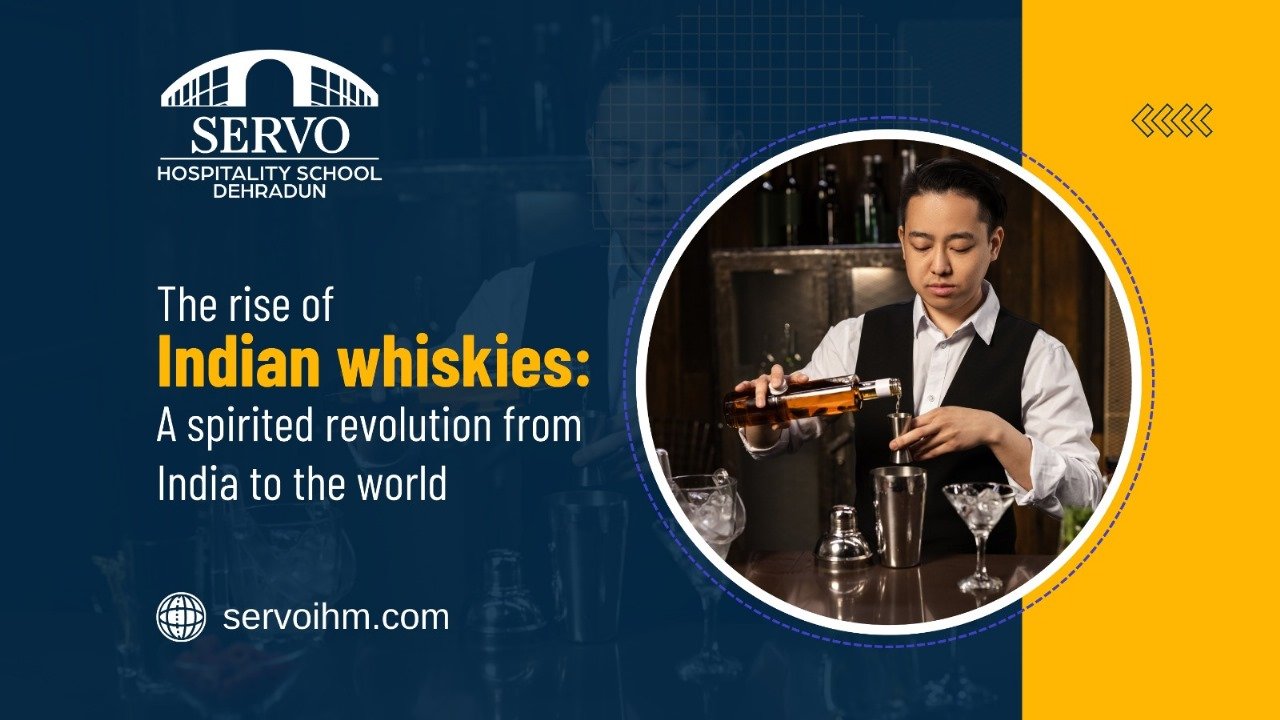
The rise of Indian whiskies: A spirited revolution from India to the world
India is not only one of the largest consumers of whisky in the world—it is now a proud producer of some of the finest whiskies globally. Over the last two decades, Indian whisky has undergone a dramatic transformation, evolving from budget-friendly blends to award-winning single malts that are now recognized on international platforms. This evolution is not just a reflection of changing tastes but also a testament to the innovation, craftsmanship, and potential of Indian distilleries.
At Servo Hospitality School, we believe it is essential for our students to understand such trends shaping the beverage industry, especially as India emerges as a global leader in premium whisky production.
ORIGINS OF INDIAN WHISKY
The history of Indian whisky dates back to the colonial era, when British officials stationed in India brought their deep-rooted love for Scotch whisky with them. To meet the growing demand without relying on expensive imports, local producers began experimenting with what was available—primarily molasses, a byproduct of the sugar industry. Unlike traditional Scotch, which is made from malted barley and aged in oak casks, early Indian whiskies were often blends of neutral spirits derived from molasses, infused with flavourings to replicate the taste of whisky. These early concoctions, though technically not classified as whisky by global standards, became widely accepted in India due to their affordability and easy availability.
For decades, the Indian whisky market was dominated by these economical blends, with brands like Royal Stag, Bagpiper, and McDowell’s becoming household names. While these products met the demands of a growing middle class, they lacked the depth, authenticity, and craftsmanship associated with traditional grain-based whiskies from Scotland or Ireland. However, this phase laid the foundation for a larger transformation. As India’s economy liberalized in the 1990s and global exposure increased, consumer preferences began to shift. Indian distillers started to explore quality, tradition, and innovation—setting the stage for the rise of premium Indian single malts that would soon earn global acclaim.
THE GAME CHANGERS: AMRUT AND PAUL JOHN
The modern era of Indian whisky began in 2004, when Amrut Distilleries, based in Bangalore, launched India’s first single malt whisky for the international market. To the surprise of critics, it wasn’t just good—it was exceptional. In fact, Amrut Fusion was rated among the world’s top whiskies by renowned whisky expert Jim Murray.
Paul John Distilleries soon followed, launching its own line of single malts., further establishing India’s reputation for high-quality, tropical-aged whisky. These brands proved that India’s unique climate could offer advantages in aging and flavour development.
INDIA’S NATURAL ADVANTAGE
India’s warm climate plays a crucial role in shaping the unique character of its whiskies, particularly in the aging process. Unlike in Scotland or Ireland, where cooler temperatures result in slow and steady maturation over 10 to 15 years, Indian whiskies age much faster—often reaching maturity in just 4 to 6 years. This is largely due to the high rate of evaporation, commonly referred to as the “angel’s share,” which in India can be as high as 10–12% annually, compared to just 2% in cooler climates. While this leads to greater volume loss, it also allows the whisky to interact more rapidly with the wood of the barrel, intensifying its flavour profile in a shorter span of time. The result is whiskies that are bold, spicy, and full-bodied, often exhibiting notes of tropical fruits, rich oak, and warm spices. This distinctive aging environment has become a defining characteristic of Indian single malts, helping them stand out in international competitions and appeal to connoisseurs seeking unique and expressive spirits.
NEW-AGE INDIAN WHISKY BRANDS
Building on the legacy of pioneers like Amrut and Paul John, a wave of new-age Indian distilleries has emerged, redefining the landscape of premium whisky. These brands combine traditional techniques with modern innovation to craft distinctive expressions that are earning global acclaim.
Rampur, crafted in the foothills of the Himalayas, is known for its smooth texture and delicate fruity notes, reflecting a rich heritage. Indri-Trini offers an exciting triple cask-matured single malt, layered with flavours of oak, spice, and vanilla. Kamet brings a modern touch through international collaborations, aging its spirit in a combination of wine, sherry, and bourbon casks. Godawan, by Diageo India, stands out for its sustainable approach, using native barley and aging in Rajasthan’s desert climate for a distinct character. These labels are now not only popular in India but are also gaining serious recognition in global markets such as Europe, the USA, and Japan—signalling a bright future for Indian whisky on the world stage.
WHY THIS MATTERS TO THE HOSPITALITY STUDENTS
For hospitality students, learning about the rise of Indian whiskies is more than just following a trend—it’s about gaining valuable industry knowledge that can shape their careers. Understanding how Indian whiskies evolved from affordable blends to globally respected single malts help students meet the expectations of today’s discerning guests and appreciate India’s role in the global beverage scene.
Knowing the stories behind brands like Amrut, Paul John, Rampur, and newer entrants such as Indri-Trini and Godawan enables students to confidently recommend and pair whiskies in professional settings—whether in fine dining, luxury hotels, or bars. This knowledge builds both competence and credibility while fostering an appreciation for the craftsmanship and innovation behind these spirits. From tasting notes to maturation techniques, students gain insights that enrich their training and prepare them for success in hospitality.
GLOBAL AWARDS AND RECOGNITION
Indian whiskies are now consistently winning medals at prestigious global competitions, marking a new era of international acclaim. Brands like Amrut, Paul John, and Rampur have earned top honours at events such as the International Wine & Spirit Competition (IWSC) and the World Whiskies Awards, often competing alongside the best Scotch and Japanese whiskies.
This growing recognition reinforces India’s place on the global whisky map and highlights the quality and innovation coming from Indian distilleries. For hospitality students, this opens up exciting opportunities—not just in service roles, but also in beverage marketing, luxury alcohol retailing, brand ambassadorship, and bar program development. Being knowledgeable about award-winning Indian whiskies adds value to a student’s professional profile and enables them to confidently represent Indian excellence on international platforms.
CONCLUSION: A TOAST TO THE FUTURE
The rise of Indian whiskies is more than a success story—it’s a movement that reflects India’s growing influence in the world of premium beverages. As students of hospitality, you are entering a world where Indian brands are no longer just following global trends—they are setting them with confidence and creativity. This is a proud moment for the Indian beverage industry and an exciting time for young professionals stepping into it.
Whether you’re training to become a sommelier, bartender, or aiming for a dynamic career in the F&B industry, understanding the journey of Indian whisky will not only enrich your knowledge but also give you a competitive edge. It helps you speak with authority, connect with global guests, and celebrate the craftsmanship, culture, and innovation that each bottle represents. At Servo Hospitality School, we raise a toast to your future—where tradition meets modern excellence, and where you are part of India’s next great story in hospitality.